

Antonio Machado arrived in Segovia on 25 November 1919 to take up the position of French teacher at the city's General and Technical Institute. He taught at this school until 1932, serving as deputy headmaster for several years.
The press at the time reported on his arrival, with newspapers writing:
"Yesterday, the vigorous and cultured poet Antonio Machado arrived in this town to take up his recently appointed position as Professor of French at the General and Technical Institute. In his beautiful verses, he has sung the praises of Castile, of which he is a fervent lover. We send him our warmest greetings and hope he enjoys his stay in this old Castilian city, where the brilliant poet will surely find inspiration." El Adelantado de Segovia. Thursday, 27 November 1919.
"Antonio Machado, the poet of Castile, returns to Castile, (...) Today he returns to Castile, coming to Segovia to teach French at our school, and here, as in that other city, he will pour into his cadenced and austere verses the deep emotions that this sister city and this fraternal countryside will awaken in the Castilian soul of this Andalusian poet. May our most beloved poet receive the warmest greetings from LA TIERRA DE SEGOVIA.‘ La Tierra de Segovia. 27 November 1919.
This same newspaper published another article on 2 December of the same year, written by M. Álvarez Cerón: ’Mr Antonio Machado: (...) We hope you will stay with us for a long time. We also hope that your soul will penetrate and take hold of the heart of Segovia. (...) Things and people, in short, await a high destiny: that you, artistically, will rhyme them. Be favourable to us. Segovia has great expectations, Mr Antonio Machado..."
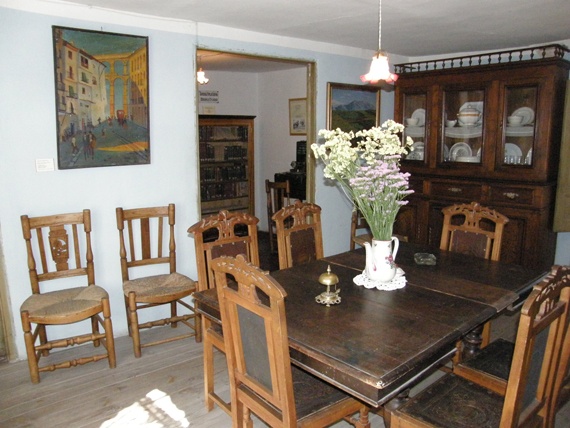
From the moment he arrived, Machado stayed in a humble house, similar to those he had occupied in Soria and Baeza and like so many others of that era. It was a modest guesthouse run by its owner, Luisa Torrego, for which he paid 5 pesetas a day. He remained there until he moved to Madrid.
In Segovia, Machado finds a cultural environment more in line with his tastes and soon connects with the most dynamic and committed sector of the local intelligentsia. He befriends men of letters, joining them to found the Universidad Popular Segoviana, a pioneering educational experience in Spain that arose from the interest of several teachers at the Institute and the Normal School a few days before the poet's arrival in the city. Machado enthusiastically welcomed this initiative and offered free evening courses to the working class, as he had done in Soria. He taught French and literary readings and led lively discussions. The aim of the Popular University was to extend culture to social sectors that had traditionally been excluded from it.
In 1920, Machado began contributing to the newspaper El Sol, the magazine La Pluma, founded by Manuel Azaña, and El Imparcial. These were years of intense activity in the press, as the author of articles with a clear pedagogical focus. This dedication would culminate during the years of the Republic with the publication of Juan de Mairena, and later, during the course of the war.
From Segovia, Machado travelled weekly to Madrid, where he closely followed cultural and political events. These were years of great tension in Spain, with a multitude of events, such as the assassination of Eduardo Dato and the disaster of Annual, which heralded the crisis that would lead to Primo de Rivera's dictatorship.
Machado was no stranger to the complicated situation the country was going through. On the contrary, he became involved with other intellectuals in a multitude of events and initiatives that sought to defend the rights and freedoms that were being violated or sacrificed in the name of order. Thus, on 4 March 1922, he signed the manifesto of the Spanish League for the Defence of Human Rights. Machado became the president of the Segovian delegation of the League and Unamuno the president of the national delegation.
A month later, on 6 April, Machado gave his first public speech in Segovia on the occasion of an art exhibition inaugurated by the Popular University to benefit the starving Russians. He did so in the courtyard of the Casa de los Picos, with the title ‘On Russian Literature’.
During these years, Machado gradually moved away from poetry to devote himself to his numerous contributions to the press, theatre, literary criticism and essays. In 1923, he published his Proverbios y cantares (Proverbs and Songs) in the third issue of Revista de Occidente, founded by Ortega y Gasset and one of the most important cultural publications in Europe. His contributions to this magazine continued from that moment on, along with others in La Pluma, España, Segovia and Alfar, a magazine from La Coruña whose editors paid tribute to Machado on 7 March 1924. Several theatrical adaptations by the Machado brothers of works by Tirso de Molina and Lope de Vega were now premiered. In April of that same year, Nuevas Canciones (New Songs), Antonio Machado's last book of poetry, was published and would be progressively expanded. It collected poems written during his years in Baeza and Segovia up to that date.
In 1925, the second edition of Páginas escogidas (Selected Pages) appeared, and the following year, in February, Antonio and Manuel Machado's first play, Desdichas de la fortuna o Julianillo Valcárcel (Misfortunes of Fortune or Julianillo Valcárcel), premiered in Madrid to great public and critical acclaim. In the following years, Antonio and Manuel Machado, taking advantage of the former's stays in Madrid, wrote and premiered five other plays: Juan de Mañara (1927), Las adelfas (1928), La Lola se va a los Puertos (1929), which became their greatest theatrical success, La prima Fernanda (1931) and La duquesa de Benamejí (1932).
Political and social events continued to concern Machado and the intellectuals of the time. On 11 February 1926, Machado signed the manifesto of the Alianza Republicana, a republican conglomerate formed on the initiative of Manuel Azaña and Alejandro Lerroux, among others, with the common goal of ending Primo de Rivera's dictatorship and the monarchy. The manifesto was endorsed by figures from various backgrounds, such as Blasco Ibáñez, Marañón, Ramón Pérez de Ayala, Ortega y Gasset and Unamuno.
The publication of Abel Martín's Cancionero apócrifo (Apocryphal Songbook) in the Revista de Occidente began. In Machado's own words, ‘Abel Martín and his disciple Juan de Mairena are two poets of the 19th century who did not exist, but should have existed, and would have existed if Spanish poetry had lived through their time’. The work Abel Martín had a long gestation period, around ten years, which began at this time.
On 23 March 1927, after eight years in Segovia, Antonio Machado was elected a member of the Royal Spanish Academy. He would never take up his seat, which corresponded to the letter V. In 1931, he drafted an inaugural speech, which remained in draft form.
On a personal level, Antonio Machado was experiencing a second youth at this time. In June 1928, Machado met Pilar Valderrama, a poet from Madrid who belonged to the upper middle class and was a supporter of the monarchy. It was in the lobby of the old Hotel Comercio. The next day, they had dinner together and took a walk to the Alcázar Gardens. This encounter revived Machado's heart. After experiencing intense love and pain due to the tragic loss of his beloved Leonor, he found solace for his heart in the poet, at the age of 53. This mature love was rather platonic, as the Guiomar of his last poems was a married woman. Even so, the relationship they maintained until the outbreak of war in 1936 revived a feeling that Machado had already forgotten.
In 1928, the second edition of Poesías Completas (Complete Poems) was published. In September 1929, he published ‘Canciones a Guiomar’ (Songs to Guiomar) in the Revista de Occidente.
Machado continued to participate actively in the country's turbulent political life. On 14 February 1931, a week after the call for legislative elections, he presided over a Republican campaign rally with the participation of Ortega y Gasset, Gregorio Marañón and Ramón Pérez de Ayala at the Juan Bravo Theatre, in the heart of Segovia's Plaza Mayor. Exactly two months later, on 14 April, the Republic was proclaimed and Machado himself raised the flag on the balcony of the Town Hall.
In September 1932, Machado was appointed professor of French at the Calderón de la Barca Institute in Madrid. The poet left Segovia in October.
The Popular University of Segovia
In the final months of 1919, a group of intellectuals from Segovia, joined by Antonio Machado, created the Universidad Popular Segoviana (Segovia People's University).
Its founders aimed to bring culture closer to the people. Among the teachers were José Rodao, writer and teacher at the Normal School; Segundo Gila, doctor; Antonio Machado, poet and professor at the Institute; Javier Caballero, architect; and Mariano Quintanilla, lawyer and graduate in Philosophy and Letters. They were joined by lecturers such as Daniel Zuloaga, Blas Zambrano, Luis Carretero Nieva, Manuel García Morente and Eugenio D'Ors.
After several years without a permanent headquarters, in 1927 the opportunity arose to acquire the former Romanesque church of San Quirce, which had been converted into a barn and warehouse. This was not only an opportunity to have their own building, but also to save the church from its likely disappearance.
They decided to create a travelling library, and to this end, each of the founders donated a number of books; in the case of Antonio Machado, fifty books from his private collection. They took this library from village to village. Part of this travelling library is preserved in the Antonio Machado House Museum.
They carried out educational missions, taking reproductions of paintings, which they displayed from the balconies of town halls; on occasions they screened films; they travelled with a phonograph, a player and a recorder, and recorded songs and romances that have survived to this day.
Photographs of all these memories, and even the phonograph, can be seen at the Antonio Machado House Museum in Segovia.
The Royal Academy of History and Art of San Quirce continues to maintain a constant cultural activity.
The Academy has been part of the Institute of Spain since 1966. In June 1997, His Majesty the King granted it the title of Royal.
Since its inception, the Royal Academy of History and Art of San Quirce has maintained an interest in all aspects of Segovian culture, advising, informing and organising exhibitions, lecture series, etc.
The city and Machado
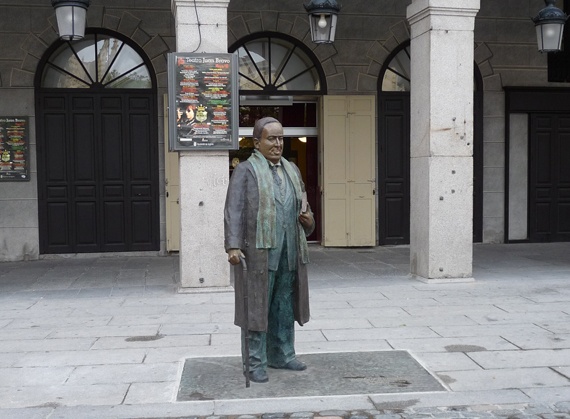
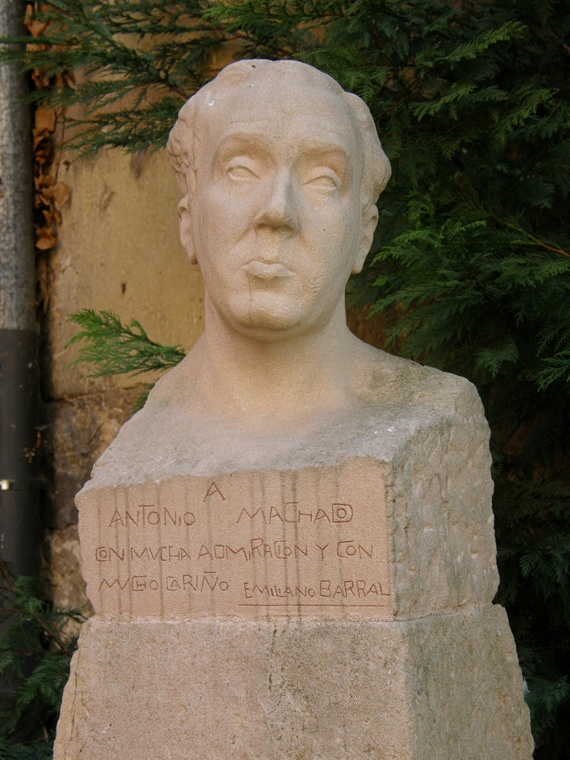
Many events are held in memory of Machado at his House Museum. One of the most important is organised on 22 February, the date of his death. Every year, poems are read in front of the poet's bust as a tribute to the writer.
The Oral Storytellers Festival is also held here, which allows visitors to enjoy recitals by contemporary poets.
The programme of activities at the Antonio Machado House Museum, organised by the Tourism Department of Segovia City Council, also pays tribute to the memory of the poet, thus contributing to the dissemination of his figure and his link with the city.
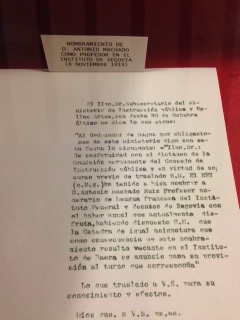
Appointment of Mr Machado as teacher at the Institute of Segovia (4th November 1919)
This appointment is preserved in his classroom in Baeza.
A public tribute to the poet (18th May 1923)
On 18 May 1923, several poets from Madrid, together with friends and colleagues of Antonio Machado in Segovia, paid tribute to the writer at the spot known as ‘El Pinarillo’.
That event was one of the first initiatives organised by those who, years later, would be recognised as members of the so-called Generation of ’27.
The tribute took place in the former guardhouse, known as the “Gran Chalet del Pinarillo”, which also served as a picnic area during the early decades of the 20th century. This new use prompted a refurbishment in the early 1920s.
In 2012, the Town Council restored the building to turn it into a small interpretation centre. Under the name ‘Casita Blanca’, it became part of the comprehensive restoration project for the Jewish cemetery.
Years later, its contents were moved to the Jewish Quarter’s educational centre, and today the little house remains closed and unused.
Next to the door, a plaque commemorates the event of 1923: “In this Chalet del Pinarillo, several poets paid tribute to Machado”.
A hundred years later, on 18 May 2023, the Royal Academy of History and Art of San Quirce commemorated that event at the very same spot.
The tribute
At the time of the tribute, Machado had been living in Segovia for three and a half years, having arrived to take up the chair of French at the General and Technical Institute, although he soon also took on the chair of Castilian Language and Literature.
The idea for the tribute to Antonio Machado came from the Madrid-born poet and novelist, Mauricio Bacarisse.
Bacarisse encouraged Machado’s friends and admirers in Madrid to pay a visit to Segovia to honour him, although he preferred to speak of a ‘visit’, a ‘pilgrimage’ or a ‘festival for poets’ rather than a tribute, as he made very clear in the invitations he distributed amongst writers, poets and journalists at court.
Antonio Machado, a man of humble disposition, tried to persuade Bacarisse to abandon the idea; however, he had no choice but to give in to the young poet’s enthusiasm.
The gathering was to consist of an al fresco lunch, scheduled for one o’clock in the afternoon, featuring typical Segovian dishes (roast lamb from Sepúlveda and rice pudding). Guests could collect their tickets at the picnic area itself at lunchtime, upon payment of eleven pesetas. The table was adorned with flowers sent by Ángel del Barrio, a councillor on Segovia City Council. Machado presided over the gathering. Seated to his right were José Rodao and Gabriel José de Cáceres, and to his left, Bacarisse and Julián Santos Blanch. The number of diners was around thirty, judging by the names that reached the press, although there may well have been a few more.
The guests from Madrid took the train from Estación del Norte. There had been speculation about the attendance of Azorín and Juan Ramón Jiménez, who were ultimately not present. The aim was to bring together a good number of guests from Madrid and limit the number from Segovia, but in the end the opposite happened, as the only attendees from Madrid were Bacarisse, Salinas, Juan Chabás and José Tudela—a friend of Machado’s from his time in Soria and the poet’s guide during the year of his arrival in Segovia—who was in Madrid at the time. Alongside him was another poet whose name was beginning to make a name for itself, particularly as a playwright: Luis Fernández Ardavín; and, with them, came the philosopher and writer Hipólito Rafael Romero Flores and, according to the press, the Segovians Ignacio Carral, a journalist and lecturer in Madrid, and Emiliano Barral, the sculptor.
There were even more of Machado’s admirers based in Segovia who attended that afternoon: the poet and journalist from Cantalejo, José Rodao, who had worked with Machado on the People’s University project; Gabriel José de Cáceres; Julián Santos Blanch; Luis Recuero; Antonio Ibot; Fernando Arranz; Javier Cabello; Manuel Pagola; Ricardo Riesco; Agustín Moreno; Florentino Soria, Juan de Vera, Antonio Ballesteros, Manuel Palomares, Antonio Sanz Gilsanz, Ramón J. Seva, Miguel Rodríguez, Mariano Quintanilla – also a colleague at the Universidad Popular and at the Instituto General y Técnico, where the Segovian had been working as an assistant lecturer in Literature for almost three years – Antonio Mazorriaga and Amadeo Ribó. All were friends and colleagues of Antonio Machado on the teaching staff of the General and Technical Institute, at the Segovian People’s University, in the literary circle, or in all three circles at once; and, in Recuero’s case, even at the boarding house on Calle Desamparados, where the poet was staying.
During dessert, Bacarisse took the floor to read out a list of names of friends who, for one reason or another, had been unable to attend, such as Eugenio d’Ors, the painter Julio Romero de Torres, the Republican MP Hilario Ayuso, the playwright Alfonso Hernández-Catá, the novelist and publisher Rufino Blanco Fombona, the postmodernist poet and literary critic Enrique Díez-Canedo, and the publishing house Mundo Latino, represented by the writers Pedro de Répide, Ramón Pérez de Ayala and Ángel Dotor. On the Segovia side, Segundo Gila, who was unwell, Blas Zambrano, Julián María Otero, the poet Marceliano Álvarez Cerón, Francisco Ruvira, Gonzalo España and the doyen of local journalists, Vicente Fernández Berzal, sent their apologies.
One of the non-Segovian poets whose absence from the tribute is most notable is Gerardo Diego. His presence might have been expected, as he was the young poet with whom Machado maintained the most extensive correspondence; however, at that time he was a teacher at the Jovellanos secondary school in Gijón and was therefore not near Madrid when the event was organised.
Once lunch was over, the poets Juan de Contreras, Marquis of Lozoya, and Mariano Grau – the youngest of those attending the tribute and a tireless researcher of Segovia’s history who had also begun his career in poetry by publishing in local newspapers – joined the gathering.
Once the meal was over, Machado expressed his gratitude to the guests with brief and heartfelt words. The poet took a piece of paper from his pocket and read one of the poems he had planned to include in *Nuevas Canciones*, a collection of poems that *Mundo Latino* would publish the following year. It was the poem alluding to the Guadarrama sanatorium, which he had seen so many times through the train window during his weekend trips to Madrid. In its final version, included in the book, he titled it ‘On the Train. Mullein Flower’ and dedicated it ‘to the young poets who honoured me with their visit to Segovia’:
Sanatorium of the Upper Guadarrama,
beyond the ash-grey rock
where the bearded goat perches,
mansion of long nights and slow fever,
do you hold a soft bed,
beneath a safe roof,
where the suffering guest may rest,
with bloodless lips and a constricted chest,
a spacious balcony overlooking the flower-filled countryside?
Antonio Machado had other texts prepared, but ultimately discarded them: ‘I chose to read them those verses which I hold dear, more for sentimental reasons than any other,’ writes Machado to justify his reading of the poem. The poet makes no secret of the fact that the chosen piece was not written for the occasion; it had already been written in 1921, although it remained unpublished as late as 1923. Machado wrote two versions of this poem: the original, the manuscript of which is preserved in Burgos, entitled ‘En tren’; and the definitive version, ‘En tren. Flor de verbasco’, included in *Nuevas canciones* (1924), within the section ‘Glosando a Ronsard y otras rimas’, numbered CLXIV in the complete poems, of which it is poem XI. The first version is dedicated to the newly built sanatorium for tuberculosis patients and dedicated ‘in memory’ of the neuropsychiatrist Nicolás Achúcarro, who died in 1918. Comparing the two versions of the poem, the greater length of the first is evident, suggesting an intention to refine the work in the second.
The final version, the one read on the afternoon of the tribute, seeks to evoke the train journey through the Sierra de Guadarrama, which the visiting poets had experienced and which they were to retrace on their return to Madrid. It is worth noting that the mullein flower, mentioned in the poem, had already bloomed in the mountains, so they were able to see its intense yellow colour as they returned to Madrid that afternoon.