A scientific tour of Segovia
On this tour, you will discover part of Segovia’s significant scientific heritage. It is a tribute to the scholars, both from Segovia and elsewhere, whose work helped shape this legacy. During the tour, we will discuss the notable figures—both locals and visitors—who made significant contributions whilst working in our city. Segovia provided the ideal environment for them to pursue their scientific work and, in doing so, contribute to progress.
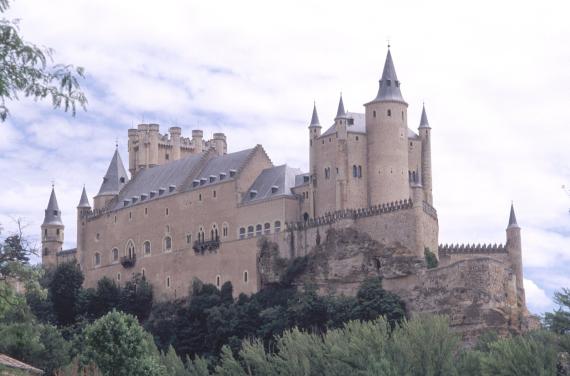
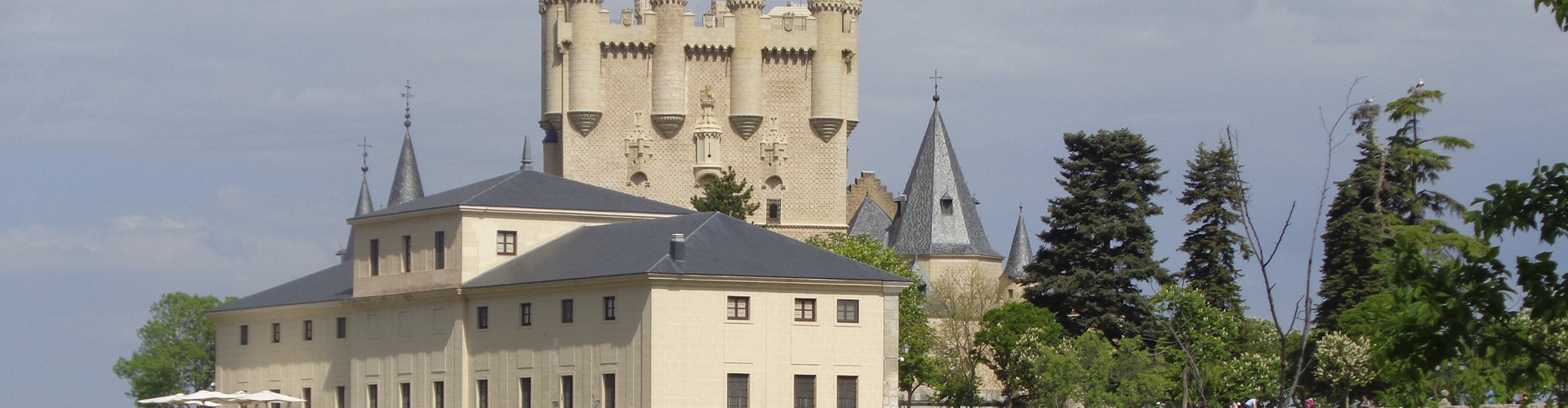
A good starting point for this tour is the Alcázar; King Alfonso X the Wise spent periods there and frequently convened the Court there. From one of its towers, surrounded by Arab and Jewish astronomers and mathematicians, he devoted many of his nights to studying the positions and movements of the celestial bodies and stars.
We can consider Alfonso X to be the only scientific king in our history. The monarch himself coordinated and partly authored the work; in the Books of Astronomical Knowledge, the astronomers assembled by Alfonso X translated the works carried out by the Arabs, updating and improving them. These works describe the celestial spheres, list stars with their coordinates, and examine instruments: astrolabes, quadrants, sundials and water clocks…
It is said that the monarch went so far as to remark that if he had been involved in the creation of the world, he would have done some things differently. He was referring to the order of the heavens. Legend has it that the consequence of this statement by Alfonso X was that a terrible storm broke out, and that a bolt of lightning struck the Alcázar in our city, causing a fire. It was considered a divine punishment for the monarch’s arrogance… and, having repented, after confessing he ordered a small room in the castle, known as La Sala del Cordón, to be decorated with a Franciscan cord.
Isaac Newton, in his book *Mathematical Principles of Natural Philosophy*, possibly the most influential scientific treatise in history, refers to the scientific activity taking place in our city during the time of the Wise King.
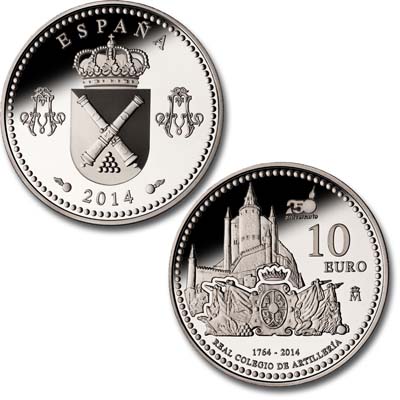
We recommend you go inside the Alcázar and visit the museum rooms of the Royal College of Artillery. The scientific and technological advances that took place from the 17th century onwards had a rapid and significant impact on the military practices of artillerymen and engineers. A military career became a profession requiring a high level of scientific qualification, and this led to the emergence of military academies throughout Europe dedicated to providing this training to professional soldiers.
On 16 May 1764, the Count of Gazzola, on the initiative of Charles III, founded the Royal College of Artillery at the Alcázar of Segovia. This military academy went on to become one of the most prominent educational institutions in the scientific and military sphere of the Spanish Enlightenment. It remained in the fortress for almost 100 years, but the fire of 1862 forced its relocation to the Convent of San Francisco, where it still remains today.
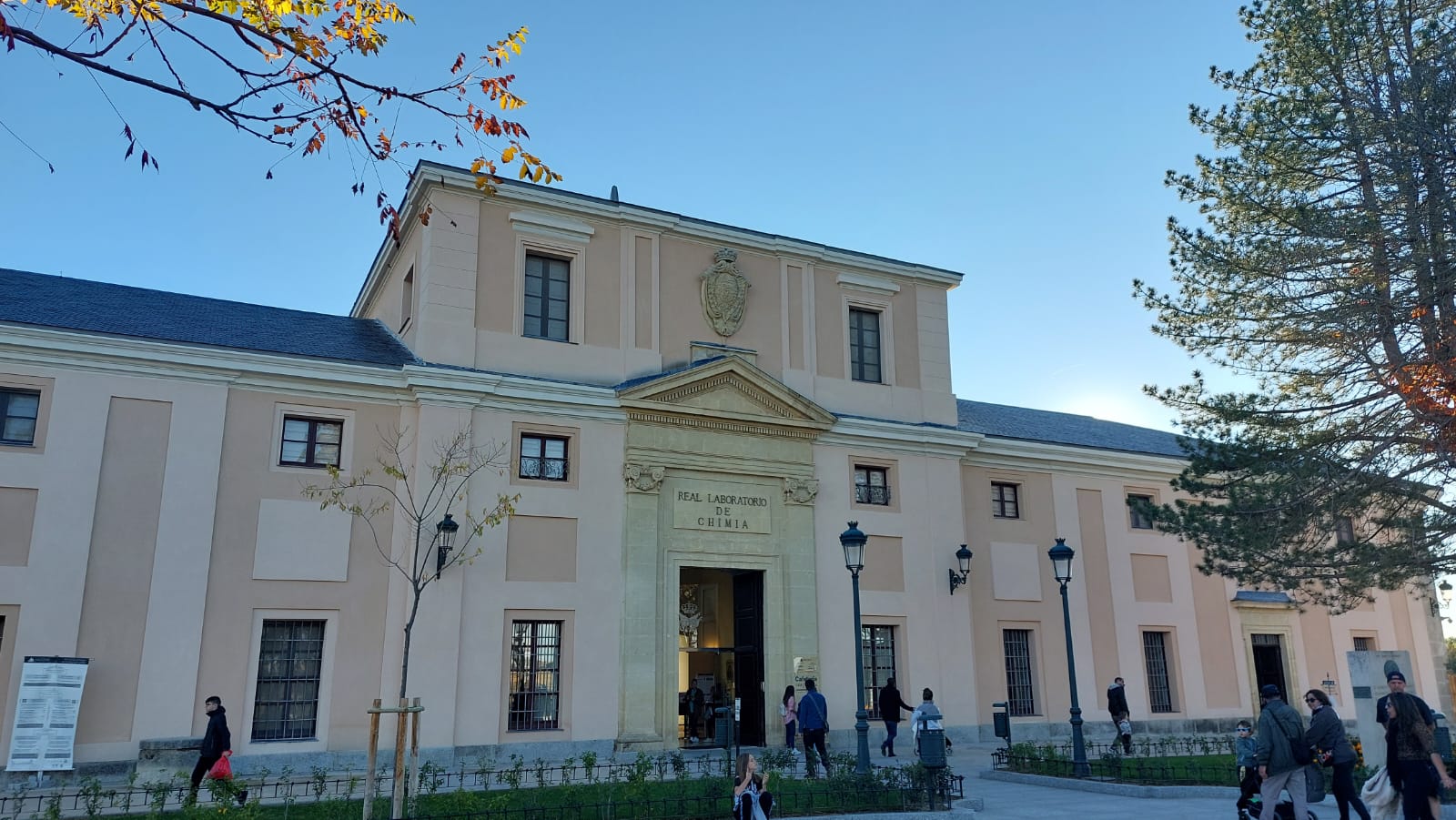
Louis Proust, the French chemist, was appointed to head the Royal Chemistry Laboratory of the Royal College of Artillery. Proust spent five years preparing it, and it was inaugurated in 1792, with Proust himself delivering the Opening Address. It is important to note that the laboratory’s teaching activities were not limited to the training of cadets; they were open to the general public.
Once you have finished your visit to the galleries of the Royal College of Artillery Museum and have passed through the gates leading to the Alcázar gardens, head to the right to take the Ronda de Juan II. As you walk alongside the wall towards the next stop, you can enjoy the wonderful views of the Clamores Valley and the old Jewish cemetery…
At number 1 Calle Martínez Campos stands the house of the forestry engineer Joaquín María Castellarnau, who was born in Tarragona in 1848 and joined the Commission for the Valsaín Pine Forest as a forestry engineer at a very young age. On the façade there is a plaque proposed by the Royal Academy of Sciences of Madrid, and in the entrance hall you can see a commemorative plaque proposed by the Cercle Catalá and Tarragona City Council. Castellarnau’s scientific interests were very wide-ranging; his work extended to microbiology, microscopic photography, botany, zoology, ornithology and astronomy. Together with Father Fidel Fita and Jesús Grinda, he carried out the first studies and research on the Jewish cemetery, with the results being presented at the Royal Academy of History by Fita himself. Castellarnau was an eyewitness to the fire that destroyed what had been the first Great Synagogue, and at the request of Fita, president of the Academy, he drafted a report with the rigour, clarity and conciseness that characterised him. This report was read out at the session marking the opening of the new academic year. The research initiative launched by the Jesuit Fidel Fita in 1886 led to the permanent recovery of Segovia’s Jewish past.
The cedar tree that Castellarnau himself planted in the garden of his house is impressive; the tree is approximately 130 years old. Inside his house, Castellarnau set up his private laboratory for microscopy and microphotography, which eventually became the headquarters of the Micrographic Commission of Spanish Forest Flora.
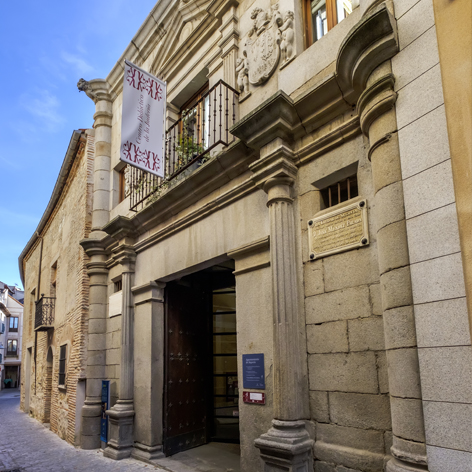
Continuing our walk, we arrive at Calle Judería Vieja 12. This house is known to the people of Segovia as the House of Abraham Seneor and the House of Andrés Laguna. It was here that Luis Núñez Coronel lived; a priest, Doctor of Theology, and a follower of Erasmus’s ideas. He was the nephew of Abraham Seneor, who was the most prominent Jewish figure in Segovia’s Jewish community.
Núñez Coronel was born in Segovia around 1480. He lived and studied in Paris alongside his brother Francisco at the College of Montaigu, at that time a centre of outstanding academic activity and considerable prestige; among its pupils were Luis Vives, Erasmus, Calvin and Ignatius of Loyola… He also studied at the Sorbonne, eventually becoming a lecturer at both institutions. King Charles V appointed the two brothers as counsellors and preachers to the Court.
Some time later, Andrés Laguna, possibly Segovia’s most cosmopolitan figure, lived in the same house. Laguna, a physician and humanist, was born around 1510; his background as a convert is perhaps the factor that best explains his early restlessness, which would lead him to become a tireless traveller throughout Europe. From his father he inherited a passion for medicine and botany; the latter was considered a discipline of vital importance in the therapeutic practice of the time, as the plant kingdom was believed to possess healing properties essential to the maintenance of human life.
He travelled through cities such as Salamanca, Paris, Cologne, Lisbon, Toledo and London, where he studied Greek, philosophy and anatomy, as well as medicine, under the guidance of great masters. It was in the border town of Metz that he carried out commendable work, combating the plagues of 1542 and 1543 with his remedies.
In Bologna he obtained his doctorate, and in Rome, amongst other titles, those of Soldier of St Peter and Personal Physician to Pope Julius III. It was in Italy that Laguna worked on his magnum opus, the translation and commentary on *De materia medica*, the classic compendium of pharmacopoeia by Dioscorides, a first-century Greek physician. El Dioscórides de Laguna became widespread in Spanish medical practice, serving as an essential reference for the description of medicinal substances at least until the end of the 18th century, and went through sixteen editions.
At this point, we can take the opportunity to visit the Jewish Quarter Educational Centre, a museum space managed by Segovia Tourism which occupies part of what, as mentioned earlier, was the home of Abraham Seneor and the home of Andrés Laguna.
We then head to the Plaza Mayor, to the Royal Church of San Miguel, to visit the Laguna family chapel, where the remains of Andrés Laguna rest alongside those of his parents.
We end our walk on Calle de La Trinidad, where, in a simple landscaped area, we find the bust of Domingo de Soto. A Segovian Dominican friar born in 1494, he was a cosmologist, mathematician, physicist and theologian. His scientific contribution to the science of motion is of unquestionable importance and universally recognised, but his contributions to theology and law are even more significant.