
Description
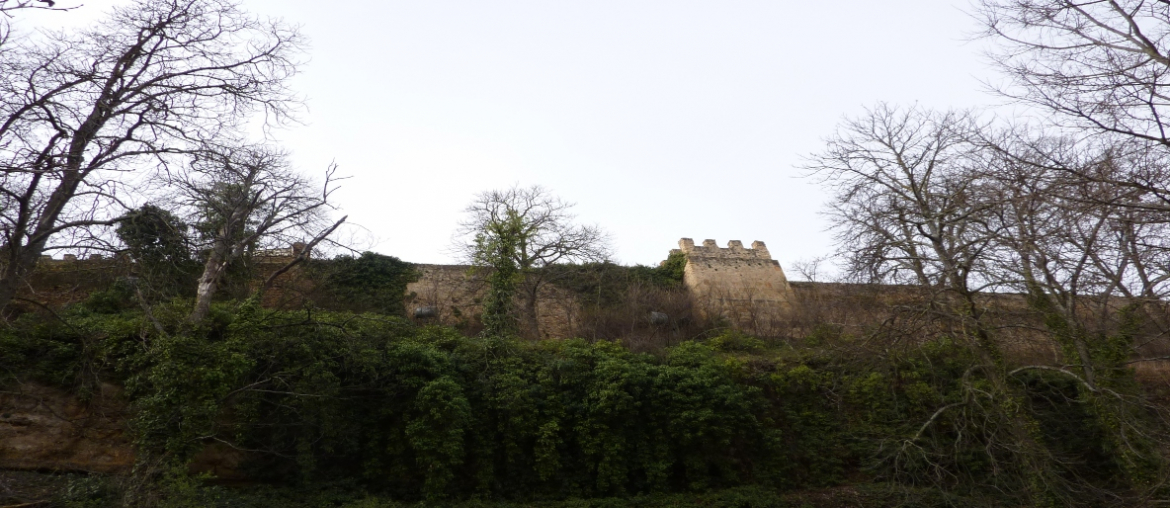
The walled perimeter adapts to the rock on which the city stands. The eastern side opens onto the Clamores Valley plain and on the western side, facing the Eresma Valley, stands the sharp corner of the Alcázar.
It is 3 km 406 m long. The walls are 2.5 m thick. The average height of the wall from the base of the rock on which it stands to the battlements at the top is estimated at 9.47 m.
Several sections can be visited (in San Cebrián, San Andrés, Ronda de Don Juan II, Obispado, Zuloaga, Postigo del Consuelo and Jardín de los Poetas).
Towers and turrets
There are an estimated 86 towers and turrets, of which 80 are currently standing. They help to stabilise and defend the wall, reinforcing the structurally weakest areas, which are always the changes of direction.
We call those with a circular base bastions and those with a square or rectangular base towers. Towers outnumber bastions.
Construction and materials
The wall was built using traditional techniques: ordinary masonry, in other areas, rammed earth with wooden formwork and in other areas formwork formed directly by a row of correctly bonded masonry. The mortar is lime and sand, low-quality sand with a high content of lean and silt, which is why we see a predominance of reddish colours.
In general, the walls, towers and cubes of the wall are made of limestone rubble.